
The Difference Between an Unfair Review and a Removable One
Many business owners assume that if a Google review feels unfair, it should be removable.
In reality, Google doesn’t judge reviews based on fairness, it evaluates them based on policy compliance. Understanding this difference is critical if you want realistic expectations and real results.
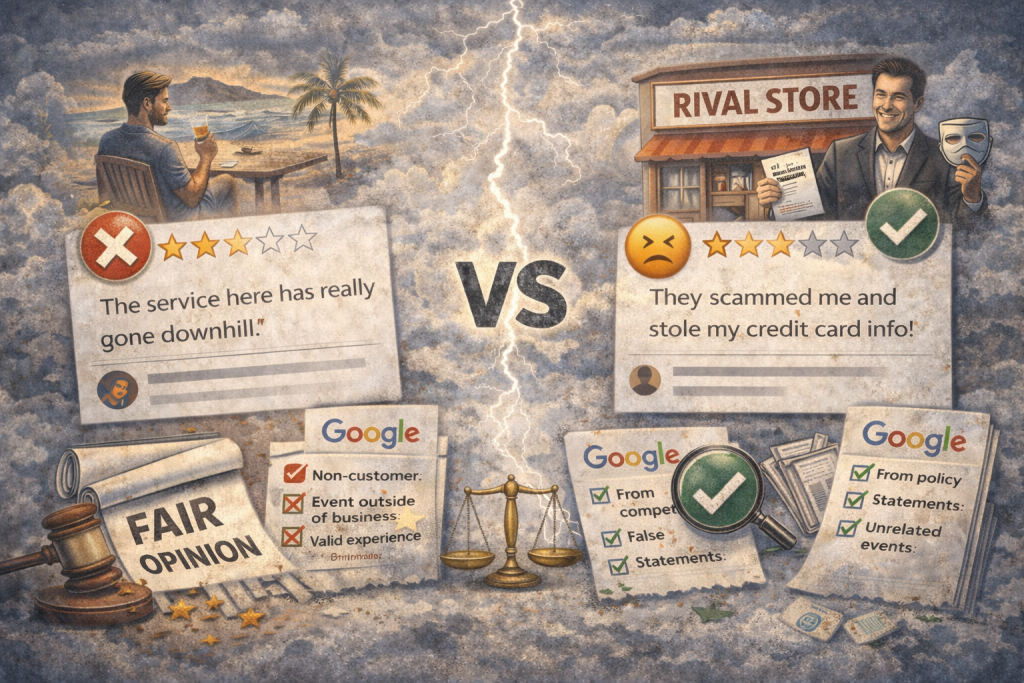
Why Google Doesn’t Care If a Review Is Unfair
Google’s review system is designed to reflect opinions, not to arbitrate disputes.
That means Google generally allows:
- Harsh criticism
- Emotional complaints
- Negative opinions based on real experiences
Even if a review:
- Exaggerates the situation
- Feels one-sided
- Omits important context
…it may still stay online if it follows Google’s content rules.
Unfair does not equal removable.
What Actually Makes a Google Review Removable
Google will remove reviews that violate specific policies – regardless of whether they’re positive or negative.
Common removal-eligible violations include:
- Reviews written by non-customers
- Competitors posting feedback
- Fake, bot, or impersonation accounts
- Reviews containing harassment, hate speech, or threats
- Off-topic reviews unrelated to the business
- False factual claims presented as truth
The key question Google asks is not “Is this fair?”
It’s “Does this violate policy?”
Unfair Review vs. Removable Review: A Clear Comparison
An unfair review may be:
- A real customer’s negative opinion
- A low rating with little explanation
- A harsh but experience-based complaint
A removable review may be:
- Written by someone who never used your service
- Posted by a competitor or former employee
- Based on events that never occurred
- Focused on individuals, politics, or unrelated issues
This distinction explains why so many self-submitted removal requests fail.
Can a Review Be Both Unfair and Removable?
Yes – but only when unfairness overlaps with a policy violation. The policy issue must be clearly identified and documented for removal to be possible.
Why Businesses Often Mislabel Reviews as “Removable”
Most business owners evaluate reviews emotionally – not strategically.
Common mistakes include:
- Trying to prove the reviewer is “wrong”
- Responding publicly before assessing policy
- Assuming Google will side with the business
- Giving up after one automated rejection
Google does not verify who is “telling the truth.”
It verifies whether rules were broken.
Respond, Remove, or Ignore? A Simple Framework
Before taking action, ask:
- Does the review violate Google policy? → Attempt removal first
- Is it unfair but policy-compliant? → Careful, professional response
- Is it old, low-impact, and compliant? → Ignore
Choosing the wrong action at the wrong time can reduce your options later.
Businesses that fall for these promises risk:
- Wasted money
- No results
- Potential harm to their Google profile
Businesses in fast-growing markets like Georgia, particularly in cities such as Atlanta, often see increased review activity as competition intensifies.
Understanding Google’s review policy helps determine when a review is simply negative and when it violates platform rules and qualifies for removal.
FAQ
Q: Can Google remove a review just because it’s unfair?
A: No. Google removes reviews based on policy violations, not fairness.
Q: Can a real customer’s review be removed?
A: Yes – if it violates policy (off-topic, harassment, conflict of interest, etc.).
Q: Does responding to a review affect removal chances?
A: It can. Responding too early may imply the interaction was legitimate and reduce removal success.
Not Sure How Google Will View a Review?
We’ll analyze your reviews for free and tell you exactly which ones may qualify for removal and which ones won’t. No pressure. No obligation.
Find out which review can be removed – free. No access required, no obligation.
Weekly tips on Google reviews, removals, and rankings.