
Google Review Policy Explained (For Business Owners)
Google reviews strongly influence trust, rankings, and buying decisions – yet most business owners don’t understand how Google actually enforces its review policies.
This guide breaks Google’s review rules down in plain English, so you know what matters, what doesn’t, and when removal is possible.
What Google Reviews Are Designed to Do
Google reviews are meant to reflect user opinions, not to determine fairness or settle disputes.
This means Google generally allows:
- Negative opinions
- Emotional language
- Harsh but experience-based criticism
Google does not remove reviews simply because:
- A business disagrees
- The reviewer is upset
- The review feels one-sided
Understanding this intent prevents unrealistic expectations.
What Google Actually Enforces
Google evaluates reviews based on policy compliance, not truth or tone.
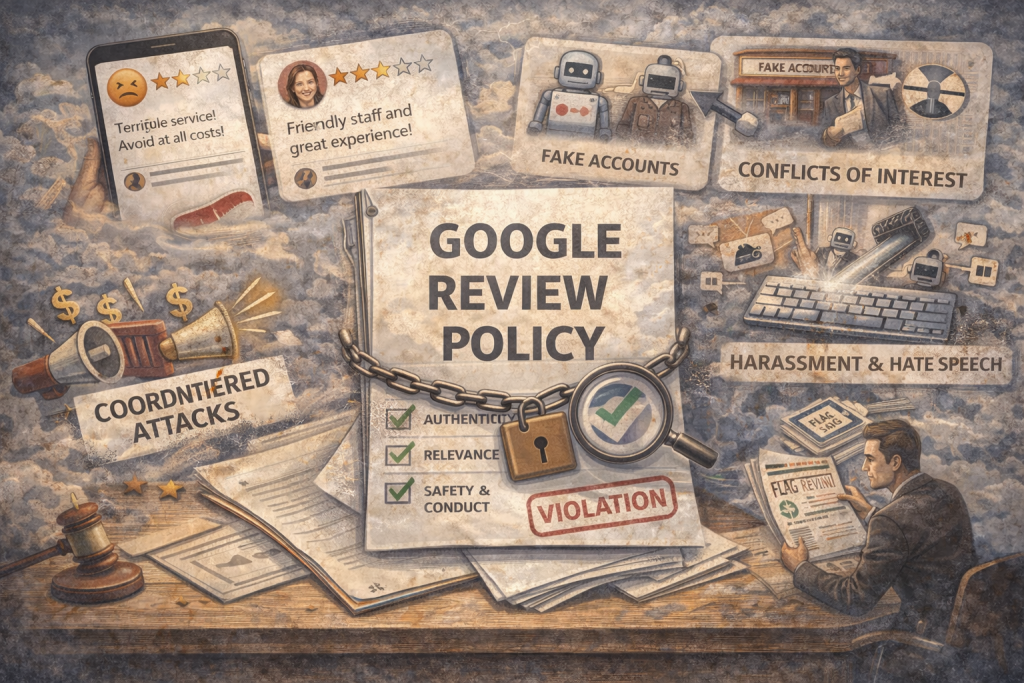
The most important policy categories include:
- Authenticity – Was there a real customer experience?
- Conflicts of interest – Competitors, employees, or biased parties
- Relevance – Is the review about the business’s services?
- Safety & conduct – Harassment, hate speech, threats
- Spam & manipulation – Fake accounts, coordinated attacks
If a review violates any of these, it may qualify for removal.
Reviews That Commonly Violate Google Policy
- Reviews written by non-customers
- Competitor-posted negative reviews
- Reviews referencing services you don’t offer
- Reviews focused on employees instead of the business
- Personal attacks, insults, or hate speech
- Fake profiles or suspicious review behavior
- Off-topic political or social commentary
These reviews may look “real” on the surface but still break policy.
Does Policy Matter More Than Fairness?
Yes. Google removes reviews based on rule violations, not whether a review feels justified. Knowing which policies apply is the difference between success and frustration.
Reviews That Typically Stay Online
Even when reviews hurt, Google often leaves them online if they:
- Come from real customers
- Stay on-topic
- Avoid harassment or false claims
- Express opinions rather than facts
Examples include:
- “Bad service, won’t return”
- Low ratings without explanation
- Emotional but experience-based complaints
These reviews may be unfair, but they are usually policy-compliant.
Why Most Policy Reports Fail
Many businesses simply click “Flag review” and wait.
The problem:
- Automated systems handle most reports
- No context is provided
- Policy violations aren’t clearly identified
Successful cases typically require:
- Correct policy selection
- Supporting documentation
- Strategic escalation when needed
Google’s system is rule-based, not intuitive.
How Google Views Review Responses
Google does not remove reviews simply because a business responds.
In some cases, responding can:
- Validate the reviewer’s claims
- Suggest the interaction occurred
- Reduce removal success later
Best practice:
- Assess policy violations before responding
- Attempt removal first if eligible
- Respond only when removal isn’t possible
Understanding Google’s review policy is only one part of protecting your reputation.
Knowing the difference between unfair reviews and removable ones and avoiding common review removal myths, can prevent costly mistakes.
FAQ
Q: Does Google manually review every flagged review?
A: No. Many reports are handled automatically. Manual review typically occurs only after escalation or strong signals.
Q: Can a real customer’s review violate policy?
A: Yes. Real reviews can still be removed if they are off-topic, abusive, or involve conflicts of interest.
Q: How long does Google review removal take?
A: Timelines vary. Some reviews are removed quickly; others require weeks and escalation.
Not Sure If a Review Breaks Google Policy?
We’ll review your Google profile for free and explain which reviews violate policy and which ones don’t. Clear answers. No pressure.
Find out which review can be removed – free. No access required, no obligation.
Weekly tips on Google reviews, removals, and rankings.