
What Google Really Considers a Fake Review
Many businesses assume that any negative or unfair Google review is “fake.” In reality, Google applies specific policy criteria when determining whether a review violates its guidelines-and many reviews that feel fake to business owners don’t qualify.
Understanding what Google actually considers a fake review is essential if you want removals to succeed. Mislabeling reviews leads to wasted time, failed flags, and frustration.
This guide breaks down Google’s definition of fake reviews, what doesn’t qualify, and how businesses can respond strategically.
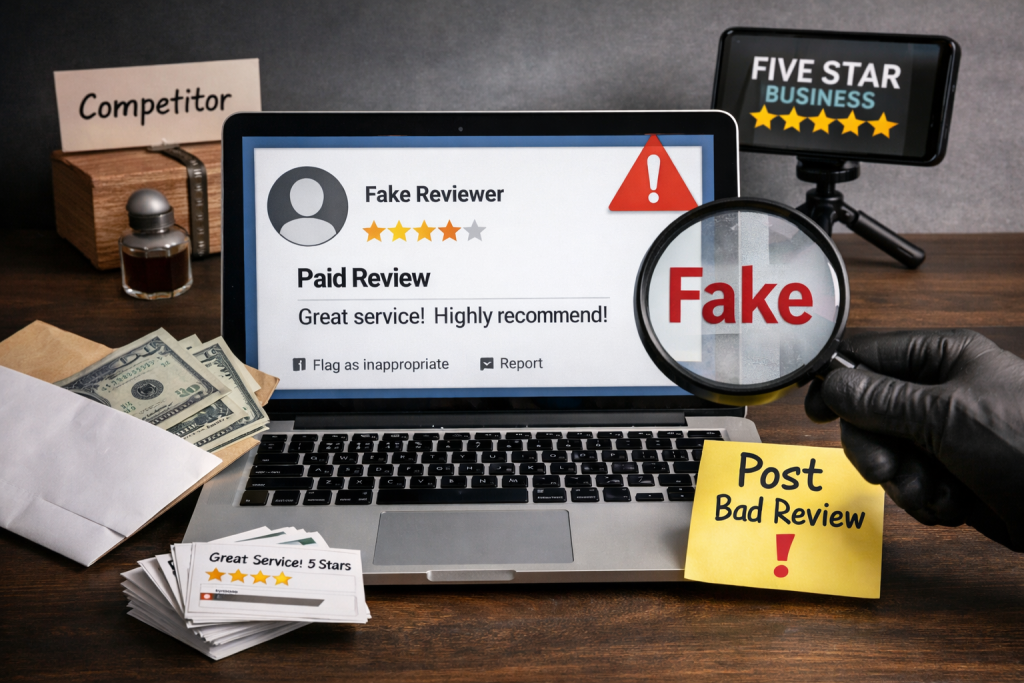
What Google Defines as a Fake Review
Google considers a review fake when it misrepresents a real experience or is posted to manipulate ratings rather than provide genuine feedback.
Common characteristics include:
- No real customer interaction occurred
- The review was incentivized, purchased, or coordinated
- The content is copied, repeated, or mass-posted
- The reviewer has a pattern of abusive or deceptive behavior
Importantly, Google evaluates context and signals, not just wording.
Types of Reviews Google Is Most Likely to Remove
1. Reviews From Non-Customers
If the reviewer never interacted with your business, the review may violate Google’s “misrepresentation” policy.
Signals may include:
- No record of service
- Incorrect details about your offerings
- Generic complaints that don’t align with your business model
2. Competitor or Conflict-of-Interest Reviews
Reviews posted by:
- Competitors
- Former employees
- Individuals with a vested interest
These can violate Google’s conflict-of-interest guidelines, but only when evidence supports the relationship.
3. Spam and Mass-Generated Reviews
Google aggressively targets:
- Repetitive phrasing across profiles
- Sudden review spikes
- Accounts reviewing dozens of unrelated businesses
These are often filtered automatically, but not always immediately.
4. Reviews Posted as Retaliation or Extortion
Examples include:
- Threats to leave bad reviews unless refunded
- Reviews tied to disputes unrelated to service quality
When properly documented, these may qualify for removal.
Unsure Whether a Review Actually Violates Google Policy?
Trustario offers a free audit to identify which reviews may genuinely violate policy, and which ones are unlikely to be removed. You only pay if a review is successfully taken down.
What Google Does Not Consider a Fake Review
Unfair or Harsh Opinions
A review can be:
- One-sided
- Emotionally charged
- Factually unfavorable
…and still be allowed if it reflects a real experience.
Reviews You Disagree With
Disagreement alone isn’t grounds for removal. Google protects subjective opinion, even when it hurts ratings
Reviews Without Proof (But Still Legitimate)
Google does not require reviewers to provide receipts, photos, or names-lack of proof doesn’t automatically mean fake.
Why Fake Reviews Sometimes Stay Online
Even when a review violates policy, it may remain visible because:
- It hasn’t been reported
- Signals aren’t strong enough yet
- Manual review hasn’t occurred
- Context is incomplete
This is why structured escalation matters more than repeated flagging.
How Businesses Should Handle Suspected Fake Reviews
- Assess policy alignment, not emotion
- Document inconsistencies and relationships
- Avoid public accusations
- Use compliant escalation channels
Results depend on accuracy, timing, and context-not volume.
Not every bad review is fake-but many reviews that violate Google’s policies go unchallenged due to misunderstanding.
Knowing what Google truly considers a fake review allows businesses to respond intelligently, avoid wasted effort, and protect their reputation the right way.
FAQ
Q: What proof does Google require to remove a fake review?
A: Google doesn’t require a single type of proof. Instead, it evaluates patterns, account behavior, and contextual signals.
Q: Can a competitor leave a review anonymously?
A: Yes. Anonymous posting doesn’t automatically violate policy-only conflicts of interest do.
Q: Why does Google remove some fake reviews instantly but not others?
A: Automated systems catch obvious spam quickly. Subtle or isolated violations often require manual review.
Q: Is flagging a review enough to get it removed?
A: Rarely. Flagging initiates review, but successful removal usually requires policy alignment and escalation.
Q: Can Trustario guarantee review removal?
A: No legitimate service can guarantee removals. Trustario operates on a pay-on-success, policy-compliant model.
Still Dealing With a Review That Doesn’t Feel Legit?
Trustario offers a free review audit to determine whether a Google review may violate platform policies and whether removal is realistically possible.
Find out which review can be removed – free. No access required, no obligation.
Weekly tips on Google reviews, removals, and rankings.